Act 1: The Pain
Like many other well known stories, this is also one about pain and discomfort.
The timeless stories I always keep reading start with some feeling of uneasiness.
Also this particular story starts with pain, wrist pain.
Since when humanity switched from manual labor in factories to CI/CD pipelines, the workforce had to quickly adapt. Welding machines or shovels, in the most bucolic scenario, were no more.
The new tool? Fingers and keyboards and pointing devices. And even if Mother Nature gave us opposable thumbs, she could never had imagined that we’ll use them, to twist and stretch them on QUERTY keyboards.
The fact is, in my very specific case, Mother Nature decided to punish my defiance against the human nature with a very sharp, burning stab feeling, aka Carpal Tunnel Syndrome.
It was in a cold month of 2019. For more than a couple of weeks, I basically lost one hand, the one I use the most of course. I’m not going to disclose which one the two, so that every reader with a similar experience will feel better immersed in the story.
Act 2: Learning to Walk Again
I cannot recall the treatment I had to do in order for the pain to go away, but I remember I was pretty tensed about it.
You know, I like to think about myself as a writer. I write in many different languages: TypeScript, Python, Golang to name a few. And recently I gave English a try. And I guess one of the writer’s worst nightmare is not being able to write anymore.
When this happened, it was at the beginning of my writing career actually, only a couple of years into that.
I definitively had to do something.
One of the first things that really resonated with me while talking to my doctor was the fact that some ergonomic mouse might help with my very personal Mother Nature’s punishment.
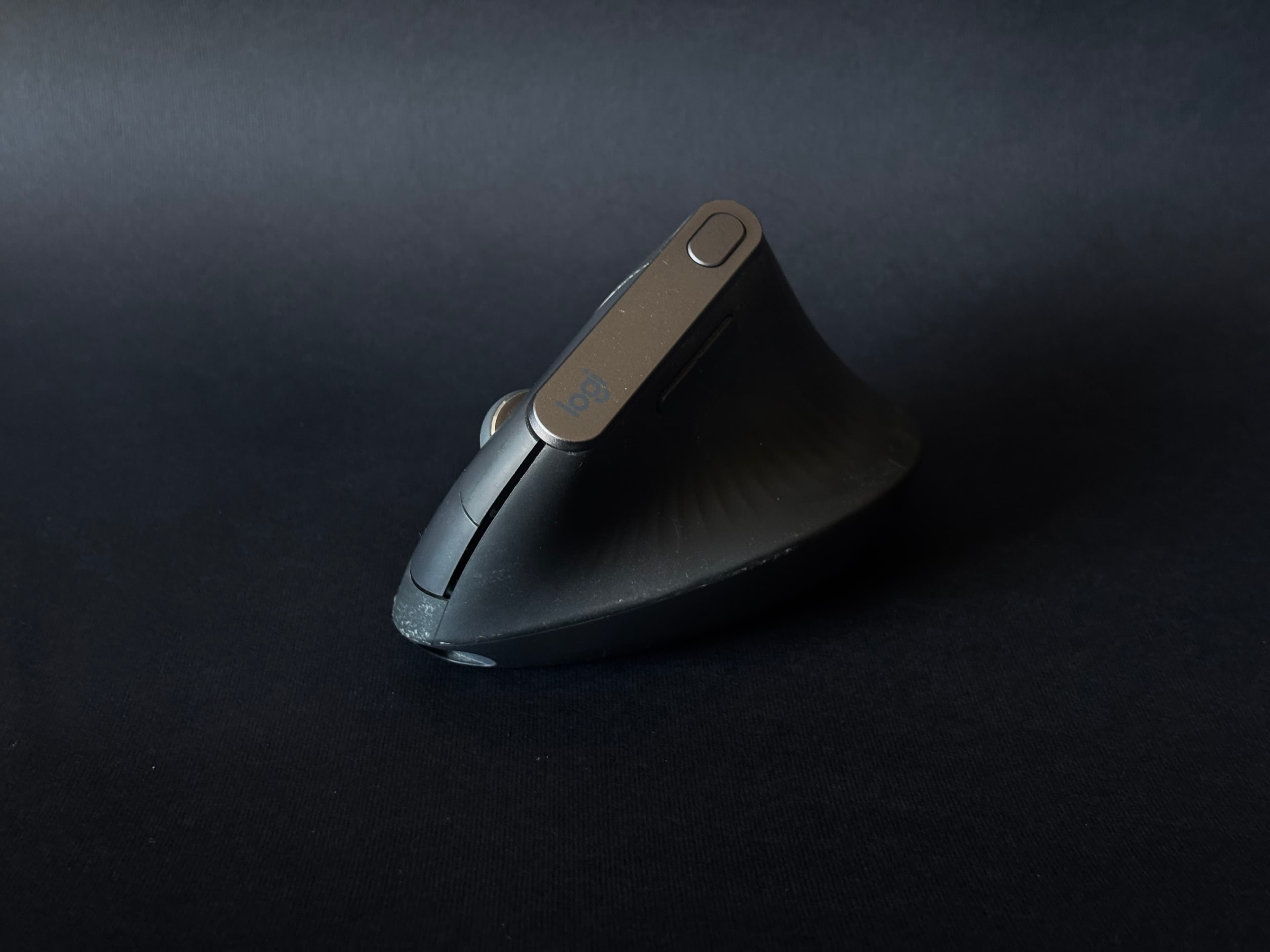
I saw the light, and the light was called Logitech MX Vertical.
Quick pause:
This blog-post is not sponsored by any means by Logitech — but, if you are reading this, Logi, let’s talk!
I can speak Italian and I live near Switzerland😉
At that time, there were no many great alternatives (also from the same brand I decided to use), so that choice was almost mandatory.
But the reality is also that I keep using the same mouse I purchased that year.
Other than some heavy signs of use, and rubber that sometimes is a bit sticky (by the way, just clean it with isopropyl alcohol, and it goes back to a less-gross state), it kept working with only few very minor hiccups.
But let’s go first back in time a bit.
I received “the light”, plugged it in, awesome app interface, the cursor actually moves on my computer screen: magic!
But…
DAMN, IT WAS HARD TO USE!
Moving the mouse was easy, but clicking is a completely different story. The mouse click was my very first boss fight in this ergonomic journey.
The main problem was the fact that mouse buttons were not parallel to the desk, so that when they are clicked, the mouse stays there. In a (very) vertical mouse, like the Logi MX Vertical, the force of my finger clicking the vertical button was making the mouse to move sideways, leading to thousands of misclicks.
First the physical pain, then the mental exhaustion of not being able to click things on the screen, I was desperate. It felt like learning how to walk again — and you’ll see this is a feeling that will accompany me throughout this whole journey.
One mis-click after another, my brain started to learn again how to do it, but vertically this time. I believe that I started being comfortable with it again after a couple of weeks.
After a month into all of this, I thought I was set for life. I was fearless and ready to just focus on my career as a writer.
But this particular journey, as many other famous ones, has three acts.
Act 3: The Ergonomic Battle
I lived most of my days writing and clicking.
I did that for almost four years, until 2023. The clicking part was kind of fixed: I was comfortable, I was sure about each one of them.
About the writing part… well, I got reminded from time to time about my human limits.
During very long writing sessions I sometimes started to feel my wrist burning, but nothing that serious, and especially nothing that couldn’t be fixed with a coffee break.
The problem is that, as humans (and you might agree with me if you also have both a sensitive Median Nerve and the Prometheus syndrome) we don’t wanna be stopped by our physical limits, and we keep pushing ourselves.
Being stopped by some physical pain rather than mental exhaustion, is very annoying, especially if you are just sitting on a chair.
That’s when I started to look around for a solution.
I first saw this interesting concept of a split keyboard, that you could mount diagonally (aka tenting) and position away from each other to force you to close your shoulder blades and be straight while seating.
Then I went deeper into the rabbit-hole, and I started learning about ortholinear keyboards, and then about staggered columns (not rows!).
I know, that’s a lot to absorb! So let’s take just a couple of minutes of intermission from this story.
Intermission:
A normal keyboard has a staggered rows design, meaning that, for example, if you are using a QWERTY keyboard, the Q key is moved few millimeters to the left of A, therefore they are not vertically centered. But the letter Q is horizontally centered with its neighbor W. This means that the keyboard has rows that are staggered. And this cases a lot of problems actually!
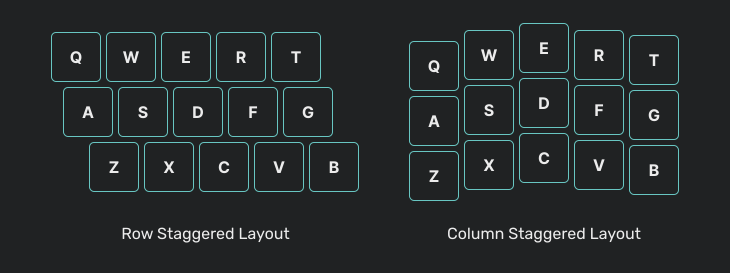
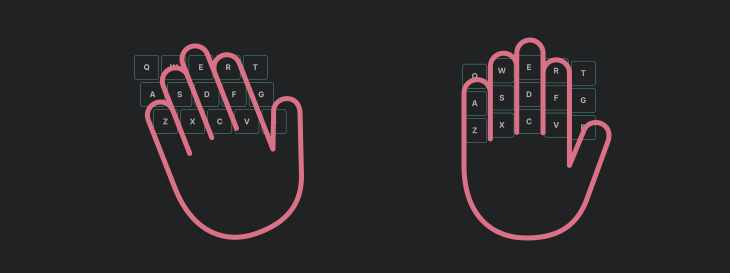
The row staggering is making your fingers twist diagonally when typing.
Usually index fingers should be positioned on the letter F and J respectively. That’s also why you have that nice tactile dent on those keys, so that your index fingers could be positioned without even looking at the keyboard. This hand position will make sure that you’ll be able to reach (more or less) all mostly used keys.
So you might be thinking: why keyboards are like that? There must be a reason behind the fact 99% of them are like that, right? RIGHT?
Right! But… the reason is because old typewriters needed some physical space to accomodate keys mechanisms. But in today’s digital world, there is no reason to stick with that anymore, also because our fingers are not naturally created to stretch diagonally (right?).
People got used to write on typewriters, and nobody among the big players (I’m still talking to you Logi) bothered to be brave and really revolutionize this market.
I don’t wanna go through a whole history lesson here, and maybe thos might be the topic for another post where we dive deeper into the finger mechanics and how split, ortholinear, column-staggered keyboards accomodate their needs.
Back to the story:
Out there, in the wild, there are few companies that still care about this. They are a niche, but this group is slowly expanding.
The reason behind this slow growth is also the reason why I was struggling, again, when switching to my brand new mechanical, split, ortholinear, column-staggered, wireless, hot-swappable-key, OLED screen beast: it is hard to tame.
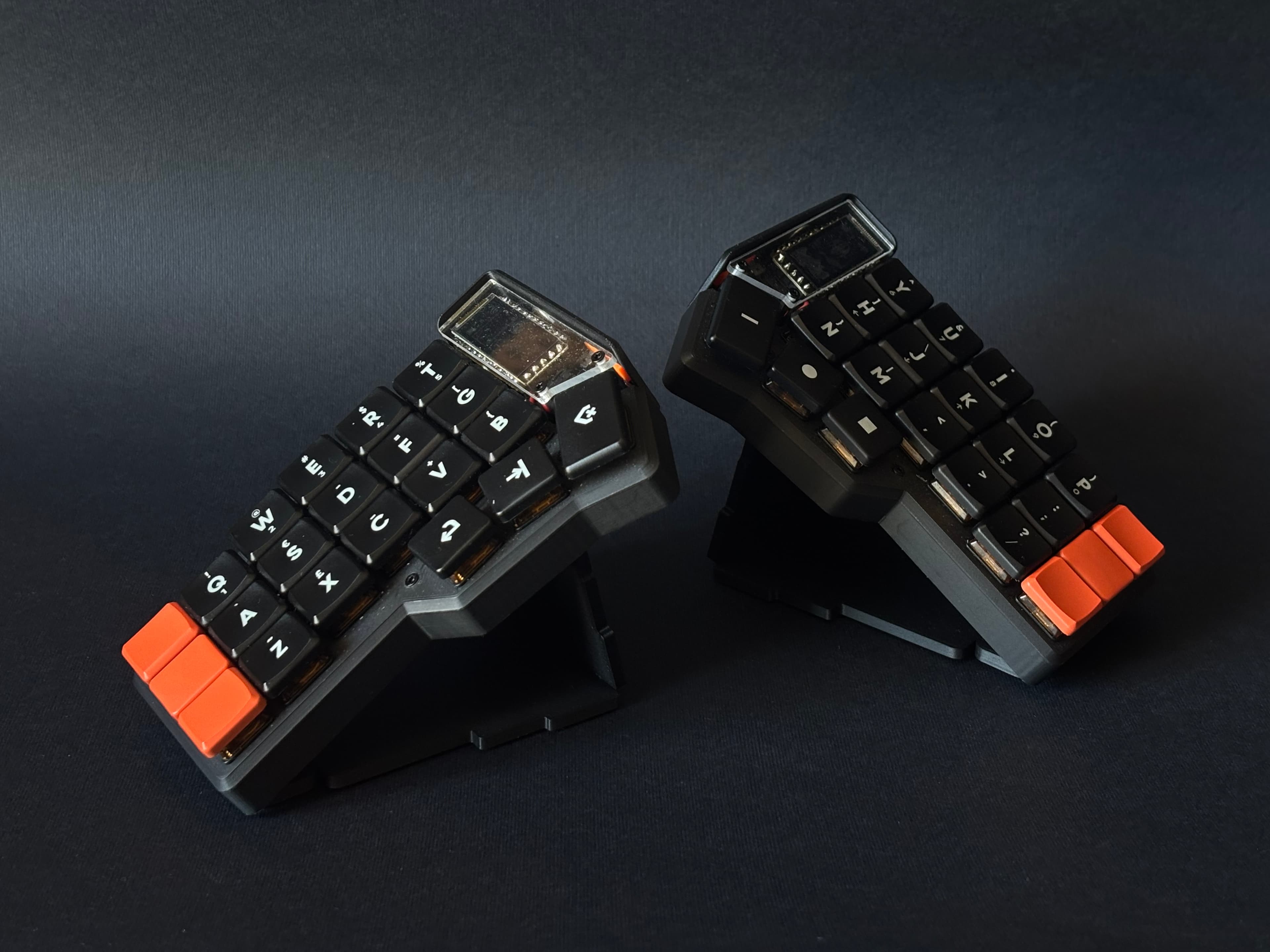
Looking backwards, the mouse miss-click experience was a walk in the park.
The real boss fight was there, in front of me, below my fingers.
It took a couple of months, not weeks, to learn how to type again — it was slow, it was painful, my wife kept complaining about the keyboard noise late at night. But it was worth it (not sure if me and my wife are aligned on that though).
After about three months, I stopped thinking how to type and more on how to go fast.
Now, even if I’m able to gracefully switch from an ortholinear keyboard to the regular laptop keyboard, every time I have to do that, I feel uncomfortable. I didn’t forget how to type on a “standard” keyboard, I just feel my fingers need to stretch and twist in weird ways to just hit the right key.
With my newly tamed beast, keys are right where they need to be, below the natural position of my fingers.
In this whole journey, I also started being introduced to DIY keyboards, and the fine art of designing and 3D-printing my own keyboard case — but that’s another story.
This painful journey ended, so far, with relief. And excitement, and curiosity to see how the ergonomic human-computer interfaces are going to evolve.